


Page 14 - Green knowledge 2025
P. 14
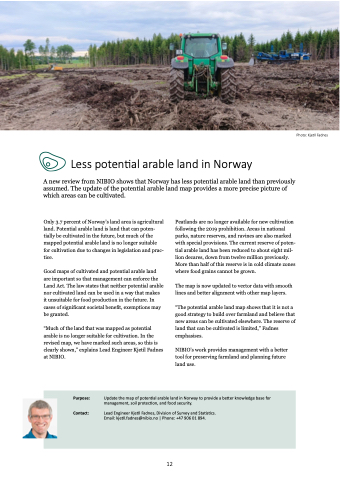
Photo: Kjetil Fadnes
Less potential arable land in Norway
A new review from NIBIO shows that Norway has less potential arable land than previously
assumed. The update of the potential arable land map provides a more precise picture of
which areas can be cultivated.
Only 3.7 percent of Norway’s land area is agricultural
land. Potential arable land is land that can poten-
tially be cultivated in the future, but much of the
mapped potential arable land is no longer suitable
for cultivation due to changes in legislation and prac-
tice.
Good maps of cultivated and potential arable land
are important so that management can enforce the
Land Act. The law states that neither potential arable
nor cultivated land can be used in a way that makes
it unsuitable for food production in the future. In
cases of significant societal benefit, exemptions may
be granted.
“Much of the land that was mapped as potential
arable is no longer suitable for cultivation. In the
revised map, we have marked such areas, so this is
clearly shown,” explains Lead Engineer Kjetil Fadnes
at NIBIO.
Peatlands are no longer available for new cultivation
following the 2019 prohibition. Areas in national
parks, nature reserves, and ravines are also marked
with special provisions. The current reserve of poten-
tial arable land has been reduced to about eight mil-
lion decares, down from twelve million previously.
More than half of this reserve is in cold climate zones
where food grains cannot be grown.
The map is now updated to vector data with smooth
lines and better alignment with other map layers.
“The potential arable land map shows that it is not a
good strategy to build over farmland and believe that
new areas can be cultivated elsewhere. The reserve of
land that can be cultivated is limited,” Fadnes
emphasises.
NIBIO’s work provides management with a better
tool for preserving farmland and planning future
land use.
Purpose: Contact: Update the map of potential arable land in Norway to provide a better knowledge base for
management, soil protection, and food security.
Lead Engineer Kjetil Fadnes, Division of Survey and Statistics.
Email: kjetil.fadnes@nibio.no | Phone: +47 906 01 894.
12


