


Page 27 - Green knowledge 2025
P. 27
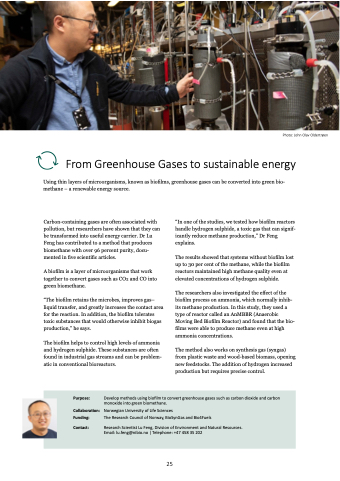
Photo: John Olav Oldertrøen
From Greenhouse Gases to sustainable energy
Using thin layers of microorganisms, known as biofilms, greenhouse gases can be converted into green bio-
methane – a renewable energy source.
Carbon-containing gases are often associated with
pollution, but researchers have shown that they can
be transformed into useful energy carrier. Dr Lu
Feng has contributed to a method that produces
biomethane with over 96 percent purity, docu-
mented in five scientific articles.
A biofilm is a layer of microorganisms that work
together to convert gases such as CO₂ and CO into
green biomethane.
“The biofilm retains the microbes, improves gas–
liquid transfer, and greatly increases the contact area
for the reaction. In addition, the biofilm tolerates
toxic substances that would otherwise inhibit biogas
production,” he says.
The biofilm helps to control high levels of ammonia
and hydrogen sulphide. These substances are often
found in industrial gas streams and can be problem-
atic in conventional bioreactors.
“In one of the studies, we tested how biofilm reactors
handle hydrogen sulphide, a toxic gas that can signif-
icantly reduce methane production,” Dr Feng
explains.
The results showed that systems without biofilm lost
up to 30 per cent of the methane, while the biofilm
reactors maintained high methane quality even at
elevated concentrations of hydrogen sulphide.
The researchers also investigated the effect of the
biofilm process on ammonia, which normally inhib-
its methane production. In this study, they used a
type of reactor called an AnMBBR (Anaerobic
Moving Bed Biofilm Reactor) and found that the bio-
films were able to produce methane even at high
ammonia concentrations.
The method also works on synthesis gas (syngas)
from plastic waste and wood-based biomass, opening
new feedstocks. The addition of hydrogen increased
production but requires precise control.
Purpose: Collaboration: Funding: Contact: Develop methods using biofilm to convert greenhouse gases such as carbon dioxide and carbon
monoxide into green biomethane.
Norwegian University of Life Sciences
The Research Council of Norway, BioSynGas and Bio4Fuels
Research Scientist Lu Feng, Division of Environment and Natural Resources.
Email: lu.feng@nibio.no | Telephone: +47 458 35 202
25


