


Page 31 - Green knowledge 2025
P. 31
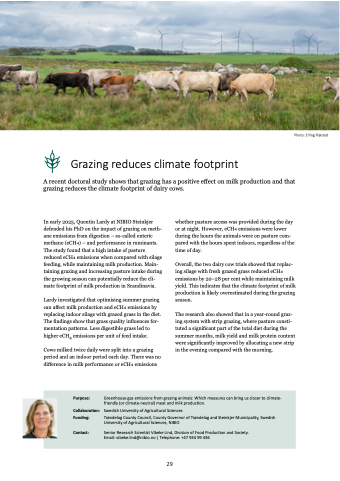
Photo: Erling Fløistad
Grazing reduces climate footprint
A recent doctoral study shows that grazing has a positive effect on milk production and that
grazing reduces the climate footprint of dairy cows.
In early 2025, Quentin Lardy at NIBIO Steinkjer
defended his PhD on the impact of grazing on meth-
ane emissions from digestion – so-called enteric
methane (eCH₄) – and performance in ruminants.
The study found that a high intake of pasture
reduced eCH₄ emissions when compared with silage
feeding, while maintaining milk production. Main-
taining grazing and increasing pasture intake during
the growing season can potentially reduce the cli-
mate footprint of milk production in Scandinavia.
Lardy investigated that optimising summer grazing
can affect milk production and eCH₄ emissions by
replacing indoor silage with grazed grass in the diet.
The findings show that grass quality influences fer-
mentation patterns. Less digestible grass led to
higher eCH4 emissions per unit of feed intake.
Cows milked twice daily were split into a grazing
period and an indoor period each day. There was no
difference in milk performance or eCH₄ emissions
whether pasture access was provided during the day
or at night. However, eCH₄ emissions were lower
during the hours the animals were on pasture com-
pared with the hours spent indoors, regardless of the
time of day.
Overall, the two dairy cow trials showed that replac-
ing silage with fresh grazed grass reduced eCH₄
emissions by 20–28 per cent while maintaining milk
yield. This indicates that the climate footprint of milk
production is likely overestimated during the grazing
season.
The research also showed that in a year-round graz-
ing system with strip grazing, where pasture consti-
tuted a significant part of the total diet during the
summer months, milk yield and milk protein content
were significantly improved by allocating a new strip
in the evening compared with the morning.
Purpose: Collaboration: Funding: Contact: Greenhouse gas emissions from grazing animals: Which measures can bring us closer to climate-
friendly (or climate-neutral) meat and milk production.
Swedish University of Agricultural Sciences
Trøndelag County Council, County Governor of Trøndelag and Steinkjer Municipality, Swedish
University of Agricultural Sciences, NIBIO
Senior Research Scientist Vibeke Lind, Division of Food Production and Society.
Email: vibeke.lind@nibio.no | Telephone: +47 934 99 436
29


