


Page 37 - Green knowledge 2025
P. 37
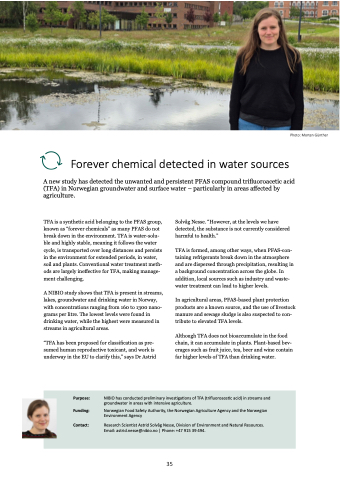
Photo: Morten Günther
Forever chemical detected in water sources
A new study has detected the unwanted and persistent PFAS compound trifluoroacetic acid
(TFA) in Norwegian groundwater and surface water – particularly in areas affected by
agriculture.
TFA is a synthetic acid belonging to the PFAS group,
known as “forever chemicals” as many PFAS do not
break down in the environment. TFA is water-solu-
ble and highly stable, meaning it follows the water
cycle, is transported over long distances and persists
in the environment for extended periods, in water,
soil and plants. Conventional water treatment meth-
ods are largely ineffective for TFA, making manage-
ment challenging.
A NIBIO study shows that TFA is present in streams,
lakes, groundwater and drinking water in Norway,
with concentrations ranging from 160 to 1300 nano-
grams per litre. The lowest levels were found in
drinking water, while the highest were measured in
streams in agricultural areas.
“TFA has been proposed for classification as pre-
sumed human reproductive toxicant, and work is
underway in the EU to clarify this,” says Dr Astrid
Solvåg Nesse. “However, at the levels we have
detected, the substance is not currently considered
harmful to health.”
TFA is formed, among other ways, when PFAS-con-
taining refrigerants break down in the atmosphere
and are dispersed through precipitation, resulting in
a background concentration across the globe. In
addition, local sources such as industry and waste-
water treatment can lead to higher levels.
In agricultural areas, PFAS-based plant protection
products are a known source, and the use of livestock
manure and sewage sludge is also suspected to con-
tribute to elevated TFA levels.
Although TFA does not bioaccumulate in the food
chain, it can accumulate in plants. Plant-based bev-
erages such as fruit juice, tea, beer and wine contain
far higher levels of TFA than drinking water.
Purpose: Funding: Contact: NIBIO has conducted preliminary investigations of TFA (trifluoroacetic acid) in streams and
groundwater in areas with intensive agriculture.
Norwegian Food Safety Authority, the Norwegian Agriculture Agency and the Norwegian
Environment Agency
Research Scientist Astrid Solvåg Nesse, Division of Environment and Natural Resources.
Email: astrid.nesse@nibio.no | Phone: +47 915 39 494.
35


