


Page 39 - Green knowledge 2025
P. 39
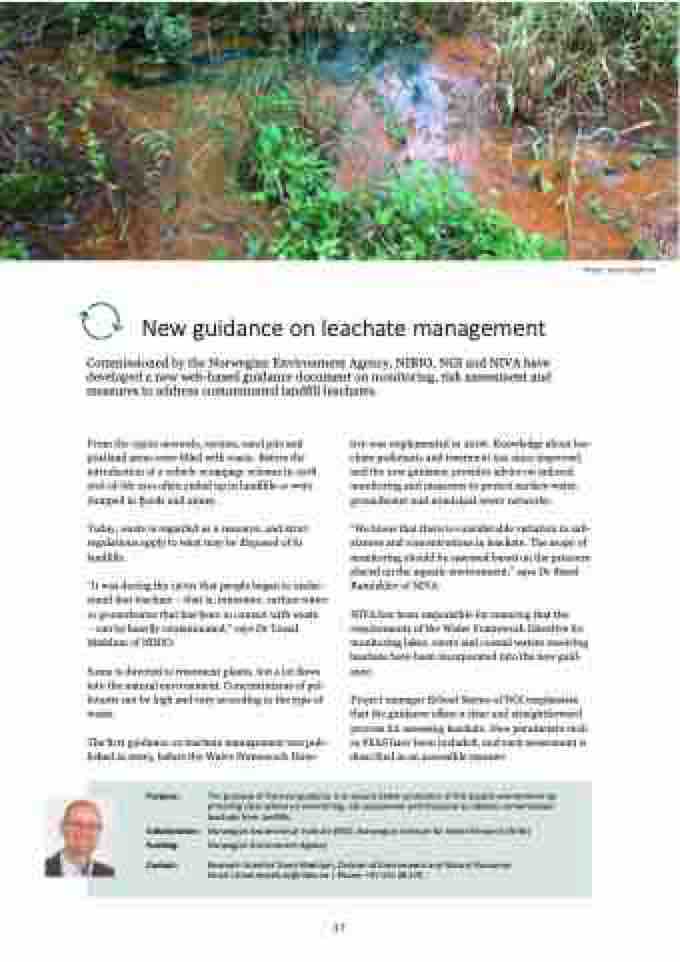
Photo: Trond Mæhlum
New guidance on leachate management
Commissioned by the Norwegian Environment Agency, NIBIO, NGI and NIVA have
developed a new web-based guidance document on monitoring, risk assessment and
measures to address contaminated landfill leachates.
From the 1950s onwards, ravines, sand pits and
peatland areas were filled with waste. Before the
introduction of a vehicle scrappage scheme in 1978,
end-of-life cars often ended up in landfills or were
dumped in fjords and mines.
Today, waste is regarded as a resource, and strict
regulations apply to what may be disposed of in
landfills.
tive was implemented in 2006. Knowledge about lea-
chate pollutants and treatment has since improved,
and the new guidance provides advice on tailored
monitoring and measures to protect surface water,
groundwater and municipal sewer networks.
“We know that there is considerable variation in sub-
stances and concentrations in leachate. The scope of
monitoring should be assessed based on the pressure
placed on the aquatic environment,” says Dr Sissel
Ranneklev of NIVA.
“It was during the 1970s that people began to under-
stand that leachate – that is, rainwater, surface water
or groundwater that has been in contact with waste
– can be heavily contaminated,” says Dr Trond
Mæhlum of NIBIO.
NIVA has been responsible for ensuring that the
requirements of the Water Framework Directive for
monitoring lakes, rivers and coastal waters receiving
leachate have been incorporated into the new guid-
ance.
Some is directed to treatment plants, but a lot flows
into the natural environment. Concentrations of pol-
lutants can be high and vary according to the type of
waste.
The first guidance on leachate management was pub-
lished in 2005, before the Water Framework Direc-
Project manager Erlend Sørmo of NGI emphasises
that the guidance offers a clear and straightforward
process for assessing leachate. New parameters such
as PFAS have been included, and each assessment is
described in an accessible manner.
Purpose: The purpose of the new guidance is to ensure better protection of the aquatic environment by
providing clear advice on monitoring, risk assessment and measures to address contaminated
leachate from landfills.
Collaboration: Funding: Norwegian Environment Agency
Norwegian Geotechnical Institute (NGI), Norwegian Institute for Water Research (NIVA)
Contact: Research Scientist Trond Mæhlum, Division of Environment and Natural Resources.
Email: trond.maehlum@nibio.no | Phone: +47 412 38 270
37


